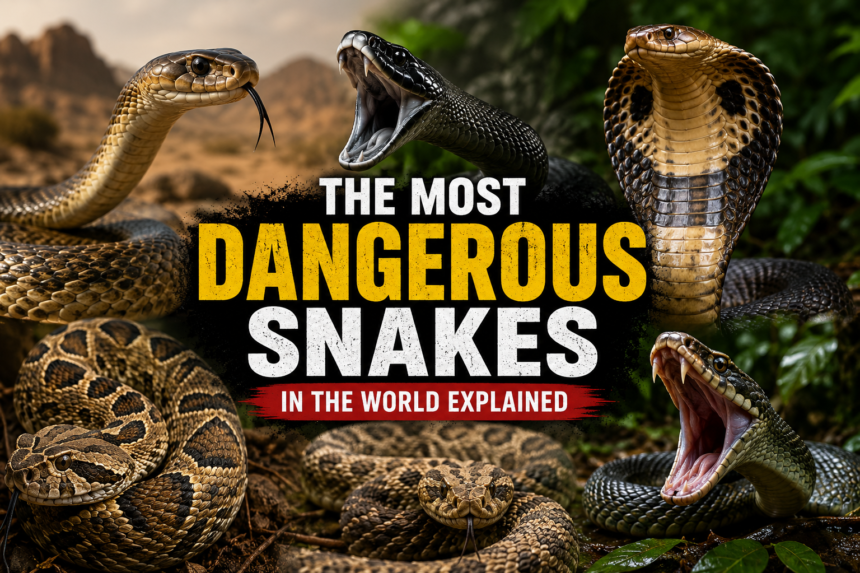
Snakes are among the most fascinating and misunderstood creatures on Earth. While most species are harmless and avoid humans, a small number possess venom so powerful that a single bite can become life-threatening within minutes.
But what makes a snake truly “dangerous”? Is it size, aggression, or venom strength?
The answer is a combination of all three. In this article, we explore the most dangerous snakes in the world, how they hunt, where they live, and why they are so feared across different continents.
⚠️ What Makes a Snake Dangerous?
A snake is considered dangerous based on several factors:
- Venom toxicity (how strong the poison is)
- Speed of attack
- Amount of venom injected
- Frequency of human encounters
- Medical access in its habitat region
Some snakes are extremely venomous but rarely meet humans. Others are less toxic but more aggressive and responsible for more bites.
🐍 1. Inland Taipan – The Most Venomous Snake on Earth

7
The Inland Taipan is often called the “world’s deadliest snake” due to its extremely potent venom.
🔬 Key Facts:
- Location: Australia
- Venom: Strongest known snake venom
- Diet: Small mammals
- Behavior: Shy and rarely seen
⚡ Why it’s dangerous:
Its venom is so powerful that a single bite could kill multiple adult humans if untreated.
👉 Ironically, it is not aggressive toward humans and lives in remote deserts.
🐍 2. Black Mamba – The Fastest and Most Feared

4
The Black Mamba is one of Africa’s most feared snakes.
🔬 Key Facts:
- Location: Sub-Saharan Africa
- Speed: Up to 20 km/h
- Venom: Highly neurotoxic
- Behavior: Defensive if threatened
⚡ Why it’s dangerous:
- Extremely fast
- Can deliver multiple bites in seconds
- Untreated bite can be fatal in under 1 hour
Despite its reputation, it avoids humans whenever possible.
🐍 3. King Cobra – The Largest Venomous Snake

6
The King Cobra is not just dangerous—it is the longest venomous snake in the world.
🔬 Key Facts:
- Location: India and Southeast Asia
- Length: Up to 5.5 meters
- Diet: Other snakes
- Venom: Neurotoxic
⚡ Why it’s dangerous:
- Can inject large amounts of venom
- Intelligent and highly alert
- Can “stand up” to eye level with humans
🐍 4. Russell’s Viper – Responsible for Many Human Deaths

6
This snake is responsible for thousands of bites every year, especially in rural Asia.
🔬 Key Facts:
- Location: India, Pakistan, Sri Lanka
- Habitat: Farms and grasslands
- Venom: Hemotoxic (affects blood)
⚡ Why it’s dangerous:
- Frequently encounters humans
- Strong venom affects blood clotting
- High fatality rate without treatment
🐍 5. Saw-Scaled Viper – Small but Extremely Deadly

8
Don’t let its size fool you—this snake is responsible for more human deaths than many larger species.
🔬 Key Facts:
- Location: Middle East, Africa, South Asia
- Size: Small (30–60 cm)
- Behavior: Very aggressive
⚡ Why it’s dangerous:
- Easily hidden in sand
- Quick to strike
- Common near human settlements
🐍 6. Coastal Taipan – Highly Aggressive Venom Machine

6
The Coastal Taipan is considered one of the most aggressive venomous snakes.
🔬 Key Facts:
- Location: Northern Australia
- Venom: Very fast-acting neurotoxin
- Behavior: Highly alert and defensive
⚡ Why it’s dangerous:
- Extremely fast strikes
- Large venom yield
- Can cause rapid paralysis
🧠 How Snake Venom Actually Works
Snake venom is a complex mix of proteins that attack different systems:
- Neurotoxins → Paralyze nerves and muscles
- Hemotoxins → Destroy blood cells and clotting
- Cytotoxins → Destroy tissue locally
Some snakes combine multiple types, making them even more dangerous.
🌍 Where Most Dangerous Snakes Live
Most deadly snakes are found in:
- Australia (highest venom diversity)
- India and South Asia (highest bite incidents)
- Africa (fast and aggressive species)
- Southeast Asia (dense snake populations)
🚑 What to Do If Bitten by a Snake
If someone is bitten:
- Stay calm (very important)
- Do NOT suck venom
- Keep limb still
- Remove tight clothing/jewelry
- Get to hospital immediately
Antivenom is the only real treatment.
🧩 Fascinating Snake Facts
- Snakes do not always inject venom when they bite
- Some snakes can detect heat signatures
- King cobras build nests (rare behavior among snakes)
- Most snake bites happen when humans accidentally step on them
❓ FAQ
Are all venomous snakes deadly?
No. Many are venomous but not strong enough to kill humans quickly.
What is the deadliest snake in the world?
The Inland Taipan is considered the most venomous.
Which snake kills the most humans?
The Saw-scaled viper causes the most human deaths annually.
Can snakes bite without warning?
Yes, but most prefer to escape rather than attack.
Is snake venom used in medicine?
Yes, it is used in developing blood pressure and pain medications.
🧾 Conclusion
Snakes are not evil or aggressive by nature—they are essential predators in ecosystems. However, some species have evolved extremely powerful venom for survival, making them dangerous when humans enter their habitat.
Understanding these snakes helps reduce fear and increase respect for nature.