When we think all about elephants: intelligence, habitat & amazing facts, we are looking at Earth’s largest land mammals, renowned for their complex emotional intelligence, versatile savanna and forest habitats, and extraordinary memory. These majestic giants play a crucial role in maintaining ecosystems while possessing cognitive abilities that rival those of primates.
Whether you are a lifelong animal enthusiast or someone exploring learning resources all about animal species, understanding these gentle giants reveals just how deeply connected they are to our planet’s history. Let’s dive into what makes elephants some of the most fascinating creatures on Earth.
The Minds of Giants: Unmatched Animal Intelligence
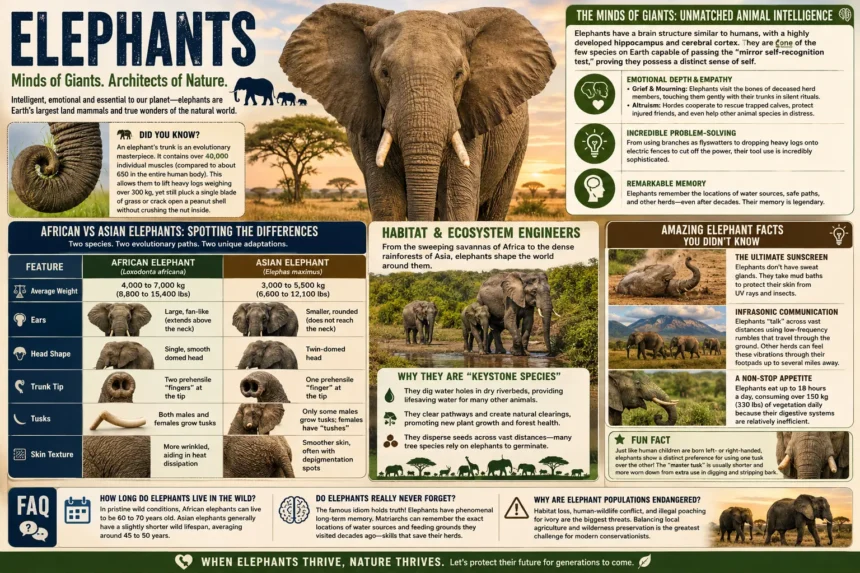
Elephants possess a brain structure remarkably similar to humans, featuring a highly developed hippocampus and cerebral cortex. This complex anatomy translates into real-world behaviors that stun wildlife researchers. They are one of the few species on earth capable of passing the “mirror self-recognition test,” proving they possess a distinct sense of self.
Emotional Depth and Empathy
- Grief and Mourning: Elephants are famous for visiting the bones of deceased herd members, gently touching the skeletons with their trunks in a silent ritual of mourning.
- Altruism: Hordes will actively cooperate to rescue trapped calves, protect injured friends, and even assist other animal species in distress.
- Problem-Solving: From using branches as flyswatters to dropping heavy logs onto electric fences to cut off the power, their tool use is incredibly sophisticated.
African vs Asian Elephants: Spotting the Differences
While they share a common ancestry, a closer look at African vs Asian elephants reveals two entirely distinct evolutionary paths shaped by their unique environments.
Key Anatomical Variations
The most immediate giveaway between the species is their ears. African elephants sport massive ears shaped remarkably like the continent of Africa, which act as natural radiators to cool them down under the intense sun. Asian elephants have smaller, rounded ears and a distinct twin-domed head, compared to the single smooth dome of their African cousins.
| Feature | African Elephant (Loxodonta africana) | Asian Elephant (Elephas maximus) |
| Average Weight | 4,000 to 7,000 kg (8,800 to 15,400 lbs) | 3,000 to 5,500 kg (6,600 to 12,100 lbs) |
| Ears | Large, fan-like (extends above the neck) | Smaller, rounded (does not reach the neck) |
| Trunk Tip | Two prehensile “fingers” at the tip | One prehensile “finger” at the tip |
| Tusks | Both males and females grow tusks | Only some males grow tusks; females have “tushes” |
| Skin Texture | More wrinkled, aiding in heat dissipation | Smoother skin, often with depigmentation spots |
🐘 Did You Know?
An elephant’s trunk is an evolutionary masterpiece. It contains over 40,000 individual muscles (by comparison, the entire human body only has about 650). This allows them to lift heavy logs weighing over 300 kg, yet still maintain the delicate precision needed to pluck a single blade of grass or crack open a peanut shell without crushing the nut inside.
Habitat and Ecosystem Engineers
From the sweeping grasslands of the Serengeti to the dense, humid rainforests of Sumatra, elephant habitats dictate their daily survival strategies. Because of their sheer size, their presence fundamentally shapes the landscape around them.
Why They are “Keystone Species”
Elephants are nature’s ultimate architects. During dry seasons, they use their powerful tusks to dig up dry riverbeds, creating water holes that provide a lifeline for dozens of other animals.
As they march through dense forests, they bulldoze pathways through thick brush, creating natural firebreaks and clearings that allow sunlight to reach the forest floor. This promotes new plant growth and allows smaller, ground-dwelling animals to navigate the terrain safely. Furthermore, they act as massive seed dispersers; many African tree species rely entirely on passing through an elephant’s digestive tract to germinate.
Amazing Elephant Facts You Didn’t Know
To truly grasp the wonder of these animals, we have to look at the bizarre and beautiful quirks of their daily biology.
- The Ultimate Sunscreen: Elephants don’t have sweat glands. To protect their skin from scorching UV rays and biting insects, they take frequent mud baths, coating themselves in a protective layer of dried dirt.
- Infrasonic Communication: Elephants “talk” across vast distances using low-frequency rumbles that travel through the ground. These sounds are so deep they are completely undetectable to the human ear, but other herds can feel these vibrations through their sensitive footpads up to several miles away.
- A Non-Stop Appetite: Because their digestive systems are relatively inefficient, elephants must spend up to 18 hours a day eating. An adult can consume over 150 kg (330 lbs) of vegetation daily.
🧠 Fun Fact
Just like human children are born left- or right-handed, elephants show a distinct preference for using one tusk over the other! The “master tusk” is easy for researchers to spot because it is usually shorter and more worn down from extra use in digging and stripping bark.
Frequently Asked Questions (FAQ)
How long do elephants live in the wild?
In pristine wild conditions, African elephants can live to be 60 to 70 years old, making their lifespans very comparable to humans. Asian elephants generally have a slightly shorter wild lifespan, averaging around 45 to 50 years.
Do elephants really never forget?
The famous idiom holds an incredible amount of truth. Elephants possess a phenomenal long-term spatial and social memory. Matriarchs (the older female herd leaders) can remember the exact locations of scarce watering holes and feeding grounds they visited decades prior, a skill that frequently saves their herds during severe droughts.
Why are elephant populations endangered?
Both African and Asian elephants face severe threats from habitat fragmentation, human-wildlife conflict, and illegal poaching for the ivory trade. As human cities expand into ancient migratory routes, finding a balance between local agriculture and wilderness preservation remains the greatest challenge for modern conservationists.